How to Style Indian Ethnic Wear for a Modern, Minimal Look
Updated: Sep 17
Minimal Indian dressing is frequently misunderstood as plain Indian dressing. It is not. Stripping everything back until the outfit has no character is not restraint, it is absence. Real minimalism is a set of choices about where to put the interest — and, more importantly, where not to.
Indian clothing is unusually well suited to this, because so much of its beauty lives in things that are quiet by nature: the fall of a fabric, the weight of a hem, the way a dupatta moves. Here is how to dress that way deliberately.
Choose one point of interest, and protect it
This is the governing rule and everything else follows from it. Decide what the eye should land on — the print, the silhouette, the embroidery, or the jewellery — and then make every other decision quieter than that one.
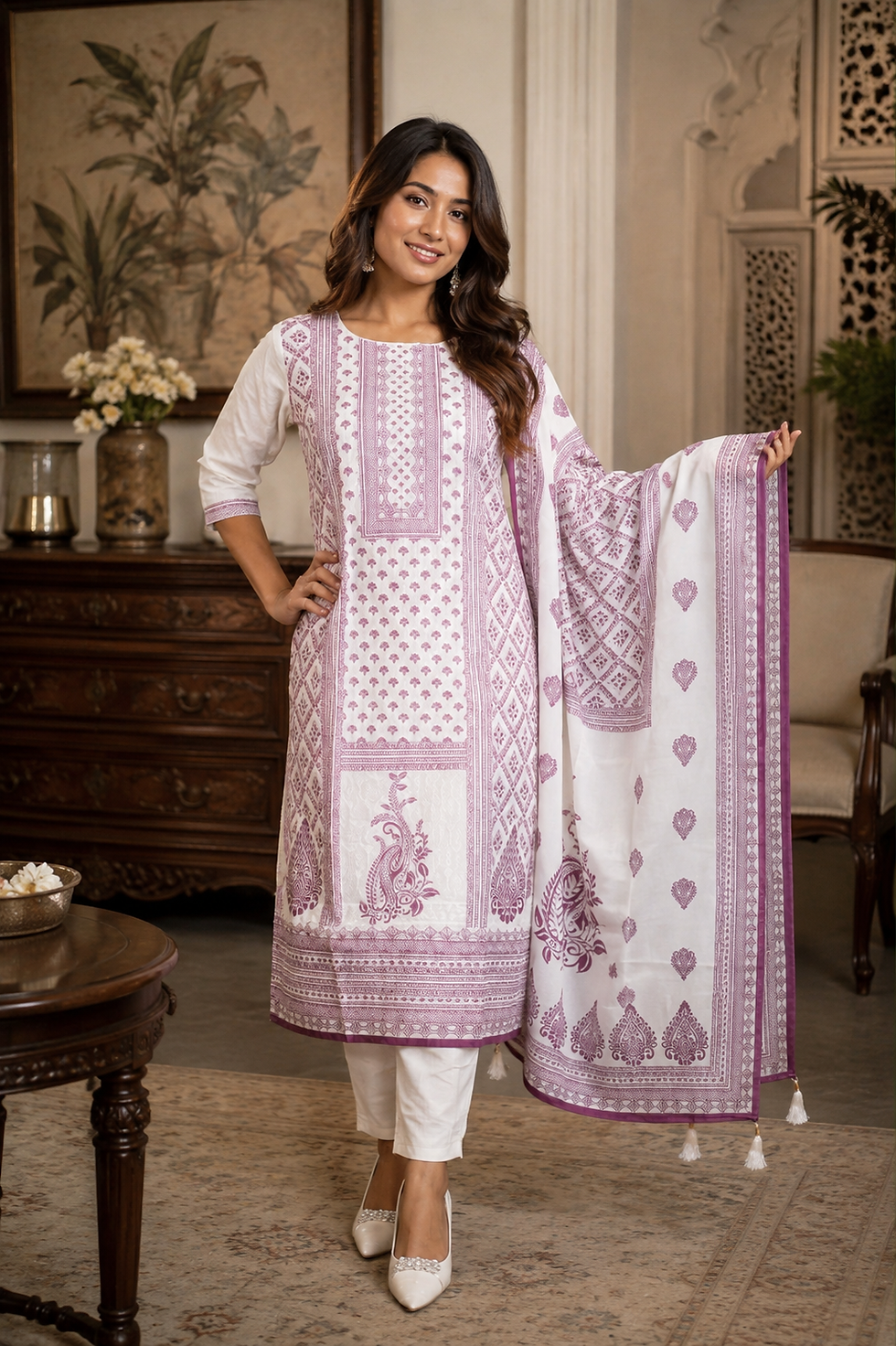
A boldly printed kurta wants plain bottoms, no dupatta, and small earrings. Heavy jhumkas want a solid outfit. An architectural silhouette wants nothing competing with it at all. Outfits look busy not because they contain too much, but because two or three things are asking for attention simultaneously.
Work within a narrow colour range
Tonal dressing is the fastest route to a considered look. Ivory with cream. Sandstone with taupe. Two shades of the same olive. When colours sit close together, the eye reads the outfit as one shape rather than several pieces, and the silhouette becomes the subject.
This does not mean avoiding colour. A deep maroon or a full indigo worn head to toe is more minimal than a careful combination of three neutrals. What matters is the number of colour decisions visible at once, not how loud any single one is.
Ombre and gradient pieces are worth noting here, because they give depth while technically staying within one colour family — an ivory and teal ombre chanderi silk kurta set does more visually than a solid without ever becoming busy.
Let the silhouette carry the outfit
When you remove ornament, cut becomes everything. A straight kurta that falls cleanly from the shoulder, a palazzo with real weight to it, a peplum that flares at exactly the right point — these read as expensive in a way that no amount of embellishment can fake.
Pay attention to where things end. Sleeve length, kurta hem, the break of the trouser over the shoe. These are the details that separate minimal from underdressed, and they are entirely about fit rather than spend. A well-fitted simple outfit will always outperform an elaborate one that sits wrong.
Accessorise by subtraction
The practical version of this: put on what you would normally wear, then take one thing off. Usually the outfit improves.
For a minimal ethnic look, a single pair of well-made gold earrings and nothing else at the neck will almost always beat a layered combination. If you want more presence, go bigger on one item rather than adding a second. Bangles are the exception — a stack reads as one object rather than many, which is why it works.
Use texture where you have removed pattern
This is the step most people skip, and it is what keeps a minimal outfit from going flat. When the palette is quiet and the print is gone, texture is what stops the look reading as thin.
Tonal threadwork, a subtly slubbed cotton, a silk with visible weave, a fine mirror detail in the same colour as the fabric — all of these add depth that only registers up close. Pieces with self-coloured threadwork are particularly useful, because they look solid from across a room and detailed in conversation.
The dupatta question
For a modern minimal look, the dupatta is usually the first thing to go. Without it, a kurta set becomes a clean two-piece and the line of the outfit stays unbroken.
When you do want it, wear it as a single narrow drape over one shoulder rather than arranged across the body. It then functions as a vertical line, which lengthens rather than layers. Keep it in the same colour family as the rest — a contrasting dupatta immediately becomes the loudest element in the outfit.
Minimal does not mean informal
A common worry is that this approach is too understated for occasions where people expect effort. In practice the opposite is usually true. In a room where most outfits are working hard, a quiet one with excellent fit tends to be the one people look at twice.
The adjustment for a formal setting is not more decoration. It is sharper grooming, better footwear, and one piece of jewellery with genuine presence. Those three shifts read as considered. Adding a second print does not.
A simple way to test any outfit
Stand in front of a mirror and ask where your eye goes first. If the answer is immediate and singular, the outfit is working. If your eye moves between two or three competing things, remove one of them and look again.
That one question resolves most styling problems faster than any rule about colour or occasion.
Where to start
If you are building toward this kind of wardrobe, begin with pieces in ivory, cream, sandstone and one deep grounding shade, in cuts you can wear three different ways. Interest can come later; the base should be quiet.
That restraint is the whole idea behind REETVESHA — Indian at heart, modern in expression, and built for women who would rather be remembered than noticed.


Comments