Co-Ord Sets for Women: Why Matching Indian Sets Work for Modern Wardrobes
Updated: Sep 17
There is a specific kind of wardrobe fatigue that has nothing to do with not owning enough clothes. It is the fatigue of matching — of standing in front of a full cupboard trying to work out which top goes with which bottom, and deciding, again, that nothing does.
A co-ord set eliminates that decision entirely. The two pieces were designed together, in the same print and the same fabric weight, with proportions that already work. That is the obvious benefit. The less obvious one is what happens when you take the set apart.
One purchase, three outfits
This is the argument that matters. A well-chosen co-ord gives you the set worn together, the top worn with plain trousers, and the bottom worn with a solid top. Three outfits from one decision at checkout.
That only holds if each half can stand alone, which is the test worth applying before buying. If the top looks incomplete without its matching bottom — because the print only makes sense across both pieces, or the hem sits at an odd point — you have bought one outfit, not three.
Why they suit Indian wardrobes particularly well
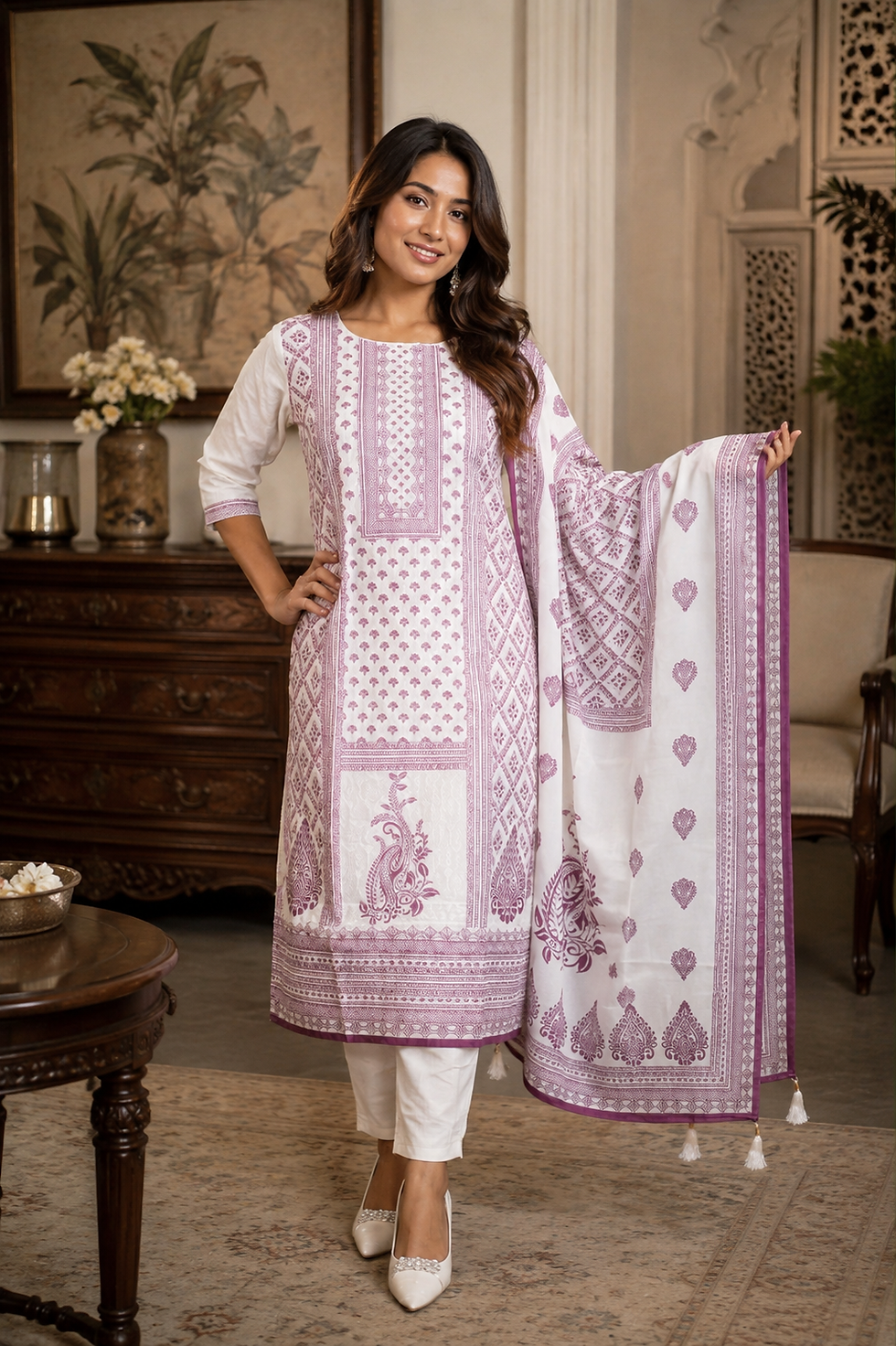
Coordinated dressing is not a borrowed idea in Indian clothing. The kurta set has always been a co-ord in everything but name — matched pieces designed as a unit. The contemporary version simply drops the dupatta and shortens the register, so the same logic works on an ordinary weekday.
The prints help too. Block prints, florals and ikat-inspired motifs read as intentional when repeated across two pieces, in a way that a single printed garment against a plain bottom sometimes does not.
Choosing one that will actually get worn
A few things separate a co-ord you reach for from one that stays folded.
Print scale matters more than print style. A medium-scale repeating print is the most wearable across contexts; very large placed prints are striking once and memorable afterwards, which limits how often you can wear them. Fabric matters next — cotton and cotton blends will be worn three times as often as anything that needs care. And check the bottom carefully, because it is usually the piece that decides whether the set works: a palazzo with real drape reads very differently from one cut flat.
A mustard yellow floral block print co-ord set is a useful example of the balance — strong enough in colour to feel like something, restrained enough in print to wear repeatedly.
Styling the set as a set
When you wear both pieces together, the outfit is already doing something. Everything else should step back.
Small earrings or a single pair of hoops. One bracelet or a watch. Footwear in a neutral drawn from the print itself rather than a contrast. A bag that is plain. The set is the statement; adding a second one makes the whole thing noisy.
Splitting it apart
The printed top over plain straight trousers is the easiest split and works for almost any daytime context. Pick the trouser colour out of the print and it will look deliberate rather than improvised.
The printed palazzo under a plain top is the better half of the split, and underused. A solid ivory or black top over a printed palazzo is a genuinely modern look and reads as more considered than the set itself in some settings. If the palazzo is busy, keep the top fitted and simple so the proportions stay clean.
Occasions a co-ord handles well
Daytime social events are the natural home — lunches, brunches, casual gatherings, daytime festive functions. The coordination reads as effort without reading as formality.
For work, a subtler print in a tonal palette handles most offices. For a festive daytime event, add a dupatta and the set immediately shifts register. For evening, split it and sharpen — printed top, solid bottom, heel, stronger earrings.
Why they are the best thing to travel with
If you pack two co-ord sets and two solid tops, you leave with four garments and arrive with eight workable outfits. Nothing else in a wardrobe compresses that efficiently.
Choose sets in fabrics that recover from being folded, keep both sets inside the same colour family so the halves cross-match, and you have covered a week of travel in a carry-on.
The short version
Buy the set where each half could stand on its own. Keep the print medium in scale and the fabric comfortable. Wear it together when you want ease, split it when you want variety, and accessorise less than you think you should.
You can see the full range of REETVESHA co-ord sets, and if you would rather build the same flexibility from separate pieces, the kurtis and tops category is the place to start.


Comments