Kurti Styling Guide: How to Wear Kurtis from Day to Evening
Updated: Sep 17
The kurti is the most quietly capable thing most Indian women own, and also the most under-used. It gets worn one way — usually the same way, with the same bottoms, on the same kind of day — when it is capable of considerably more.
This is a guide to getting a full day out of one, from morning through to evening, with the specific changes that shift it between registers.
First, know which kurti you are working with
Different cuts want different things, and most styling frustration comes from treating them as interchangeable.
A straight kurti is the most flexible — it takes almost any bottom and reads neutral. A peplum kurti has its own defined waist, so it wants a narrow bottom and nothing belted. A short kurti works best with high-waisted trousers or a skirt and looks awkward over anything loose. A sleeveless tunic is a layering piece as much as a standalone one. Identify yours before you decide anything else.
Casual and errands: let it be plain
A cotton kurti over leggings, palazzos or straight jeans, flat sandals, minimal jewellery, hair off the face. This is the version that requires no thought, and the point is that it should require none.
The only thing worth getting right is fabric. A cotton kurti in real heat will be the difference between a comfortable morning and a miserable one, and it will look better at the end of the day than a synthetic will. Something like a pink floral cotton straight kurti is precisely this category — unremarkable in the best way, worn constantly.
Office: sharpen the line
For work, swap loose bottoms for something with structure — straight trousers or a narrow palazzo. The silhouette should be vertical rather than voluminous.
Solid or subtly worked kurtis do better than large prints in most professional settings. Threadwork in the same colour as the fabric is ideal here: it reads as detail up close and as plain from across a meeting room. Add a watch, a structured bag, and closed or block-heeled footwear.
One more thing worth attention: sleeve length. Three-quarter or full sleeves read as more formal than short, and in an air-conditioned office they are also simply more comfortable.
Lunch and daytime social: this is where prints belong
Daylight is flattering to print in a way that artificial light is not. A block print, a bold floral, an ombre — all of these look their best between eleven and four.
Keep the rest quiet so the print carries the outfit: plain bottoms in a colour drawn from the print itself, small earrings, a sling bag. If the kurti is doing something interesting, nothing else needs to.
Evening: three changes, nothing more
The useful skill is shifting the outfit you are already wearing rather than going home. Three changes do almost all of it.
Change the earrings for something with real presence — jhumkas, chandbalis, anything that moves. Change flats for a heel. And change the lip. Those three moves reliably take a daytime kurti into evening, and none of them requires more than five minutes or a mirror you do not already have.
A fourth, if you have it with you: tie your hair back. Loose hair reads casual; anything pulled back reads deliberate.
Festive: add a dupatta and stop there
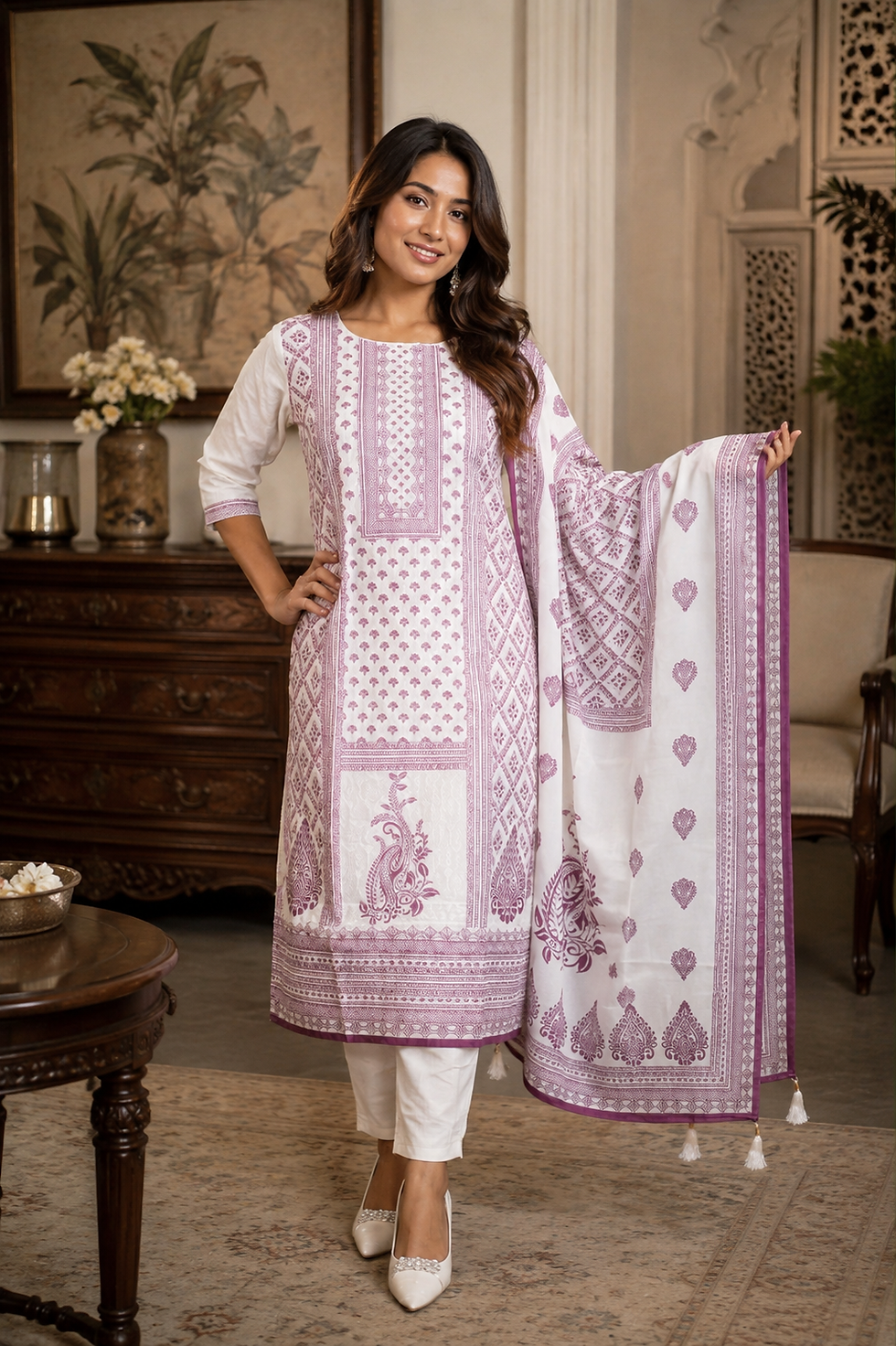
A kurti becomes festive the moment you add a dupatta, and this is an enormously underrated trick. A plain kurti with a well-chosen dupatta — something with a border, a tassel, a zari edge — will hold its own at most family occasions.
Keep the dupatta in the same family as the kurti or pick up a single colour from its print. A contrasting dupatta is a stronger statement and harder to get right; a tonal one is nearly foolproof.
Bottoms: what goes with what
Straight pants are the most versatile and the most flattering under a straight kurti. Palazzos add softness and movement, and work well with shorter or peplum cuts. Leggings are the most casual option and best kept to genuinely casual days. Jeans under a kurti are a legitimate and very wearable combination, provided the kurti has side slits.
One rule that saves a lot of trouble: if the kurti has volume, the bottom should not, and vice versa. Volume in both places is the most common reason an outfit feels wrong without anyone being able to say why.
Layering
A sleeveless tunic over a full-sleeved fitted top is a genuinely modern look and extends the life of both pieces into cooler months. A long open jacket over a straight kurti works for travel and winter. Short jackets over long kurtis rarely work — the hem line lands badly.
Building a kurti rotation that actually works
Four kurtis will cover most of a year if you choose them deliberately: one solid in a neutral, one solid in a deeper shade, one print you love, and one with tonal threadwork for days that need to look more considered.
Add two pairs of well-fitting bottoms and you have a rotation that handles work, weekends and most social plans without ever feeling repetitive. You can see the full range of REETVESHA kurtis and tops if you are filling gaps in yours — and if you would rather have the decision made for you, a co-ord set does the same job with one purchase.


Comments